Friday, September 25, 2009

Deities

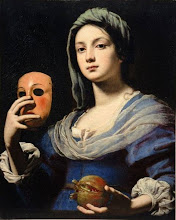
The Australian writer David Malouf was interviewed on ABC radio today. In one of his recent novels, the ancient Greek god Hermes appears. The interviewer noted that Wikipedia entries on the ancient gods get more hits than entries on Jesus, and he may have been wondering whether or not this indicates a resurgence of paganism. Though not a 'pagan', Malouf explained that the persistence of interest in deities, the reason we still feel a thrill when we read the name of a deity in a poem or story, is due to the fact that they personify eternal qualities in human beings and nature. Carl Jung called them Archetypes. Others have likened them to windows through which the Divine may be seen.
From the perspective of universal Selfhood, there is only one being. The Self is a single gem, but it has many facets, and many qualities, qualities which are eternal, which sometimes take a human form in order to evolve the same qualities in human beings.
The Monotheistic prophets emphasised the one-ness of the Self because they observed people worshipping only that aspect of the Self (usually the god of wealth or war) which they believed would satisfy their greed. The founders of Judaism and Islam saw pure archetypes becoming objects of impure desires leading away from Self-realisation, not towards it. Self-realisation requires a simultaneous respect for all aspects of the Divine Self, not just the aspect that suits one's current proclivities.
The deities have survived in monotheistic cultures, as archangels, and the vast Kherubim of the creation.

Wednesday, September 16, 2009

Russia

Advaita (the philosophy of undivided, non-dual Selfhood) could be misconstrued as being akin to soviet style collectivism - submersion of the individual in a totalitarian state.
The Austrian philosopher Wittgenstein, like many of his generation, was attracted by both Advaita and communism. He even made a visit to Moscow to see for himself how socialism was being applied there. He was not overly impressed.
Russia, under Stalin, was far from being an ego-less state. To the contrary, totalitarianism is the total dominance of society by the single paranoid ego of an autocrat. Marx's ideals can only work if everyone in a society operates selflessly for the good of the whole, including the leader.

Thursday, August 27, 2009

At the Art Gallery of NSW


The Vision of God, The Book of Job
.
This engraving by William Blake is currently on display, along with several others from the Book of Job series, at the Art Gallery of New South Wales. The Universal Self connects to human beings through the Sahasrara Chakra at the crown of the head. From the perspective of ego and superego (conditionings), universal Selfhood is terrifying. Those who still cling to these two illusory institutions are seen cowering on the right side of the composition.

Wednesday, July 29, 2009

Water


.
Water doesn't have a mind.
It doesn't have intent.
It has no desires;
even the desire to be good.
It acts according to its nature.
When you let all things return to their nature
there is harmony.

-Taoist

Wednesday, July 22, 2009

you are not your ego

When you are fighting the nature the ego develops within you. And then once that momentum has started in you it is very difficult to bring it down. It is such a terrible disease that people have taken it for granted that that’s a part of their lives. You are not your ego. You are not.
- Shri Mataji Nirmala Devi
1978, Agnya Chakra

Tuesday, July 21, 2009

The Deities Within


.

Indian painting showing the deities residing in the subtle system:
Shri Brahmadeva in the Swadisthana Chakra,
in the lower abdomen (creativity)
Shri Vishnu in the Nabhi Chakra,
at the navel (evolution and sustenance)
and Shri Shiva at the Sahasrara,
at the crown of the head
(dissolution of ego and superego through Self-realisation)

Note, Shri Shiva also resides in the left Heart Chakra. There is a strong connection between the heart and the Sahasrara Chakra.

Sunday, July 12, 2009

Shri Ganesha


So Ganesha is the killer of ego,
because humility is the only thing
that really can neutralize your ego.

-Shri Mataji Nirmala Devi
Madras (Chennai) 1991

Friday, July 03, 2009

Hazrat Ali


Name of Hazrat Ali, The Lion of Allah

"The strongest amongst you is the one who subdues his self (ego)."
- Hazrat Ali

Foreseeing literalism/fundamentalism, Hazrat Ali, the nephew of the Prophet Muhammad, taught that the Quran has many possible interpretations. The earliest Muslims understood that the text, is a poetic work with vast possibilities. Fundamentalism is a form of blasphemy, as it dares to limit the creative possibilities of the word of God.
.
The Shrine of Lord Ali


Hazrat Ali, Incarnation of Lord Brahma, the creative aspect of the Self, instructed that his burial place should remain secret. According to legend his body was placed on a camel which was driven from Kufa. The camel stopped a few miles to the west, and here the body of Hazrat Ali was buried secretly. No tomb was raised and nobody knew of the burial place except a few trusted persons. It is narrated that more than a hundred years later, the Abbasid Caliph, Harun-ur-Rashid went deer-hunting outside Kufa, and the deer he was pursuing sought sanctuary at a place where the hounds would not follow. On enquiry as to why the place was a sanctuary, Harun-ur-Rashid was told that it was the burial place of Hazrat Ali. He ordered a mausoleum to be built on the spot, where, in due course, the town of Najaf, in present day Iraq, grew around it.

"Unless and until you take Hazrat Ali’s name your Swadisthan Chakra cannot be cured."
-Shri Mataji Nirmala Devi

Monday, June 29, 2009

no 'me'


.
In my unblemished nature there are no elements,
no body, no faculties, no mind.
There is no void and no anguish.
For me, free from the sense of dualism,

there are no scriptures, no self-knowledge,
no mind free from an object,
no satisfaction and no freedom from desire.
There is no knowledge or ignorance,

no 'me', 'this' or 'mine', no bondage, no liberation,
and no property of self-nature.

-Ashtavakra Gita

Sunday, June 28, 2009

Confucius


"Wheresoever you go,
go with all your heart".

~Confucius

Friday, June 26, 2009

The Power of Silence and Zero

“Humility collects the soul into a single point by the power of silence. A truly humble man has no desire to be known or admired by others, but wishes to form himself into himself, to become nothing, as if he had never been born. When he is completely hidden to himself in himself, he is completely with God.”
- Isaac of Nineveh (AD 600)
.
A current affairs reporter was talking on TV about the Global Economic Crisis, and told viewers to brace themselves for "a whole lot of zeros", as she was going to talk about the 2.7 trillion dollars that have been lost on world markets. Seeing all those zeros after the 2 and 7 on the screen made me think about how important zeros are. Without nothing, nothing could exist. It's one of the apparent paradoxes of mysticism that to become truly nothing is to become everything.

One of my aunts mentioned that she has been reading a book called The Book of Nothing, in which the author reflects that Indian philosophy was unphased by the notions of zero and infinity, while Western schools struggled with them.
.

PS think of how many zeros that would be if you converted 2.7 trillion US to Zimbabwean dollars!
.
This 100 billion dollar note would buy a kilo of apples.

Tuesday, June 23, 2009


Eric Joyner, Sweet Buddha

Hollow at the centre; donuts symbolise our consumerist society.

Sunday, June 14, 2009

Economic Anarchy

It is only a slight exaggeration to say that mankind constitutes even now a planetary community of production and consumption. I have now reached the point where I may indicate briefly what to me constitutes the essence of the crisis in our time. It concerns the relationship of the individual to society. The individual has become more conscious than ever of his dependence upon society. But he does not experience this dependence as a positive asset, as an organic tie, as a protective force, but rather as a threat to his natural rights, or even to his economic existence. Moreover, his position in society is such that the egotistical drives of his make-up are constantly being accentuated, while his social drives, which are by nature weaker, progressively deteriorate. All human beings, whatever their position in society, are suffering from this process of deterioration. Unknowingly prisoners of their own egotism, they feel insecure, lonely, and deprived of the naive, simple and unsophisticated enjoyment of life. Man can find meaning in life, short and perilous as it is, only through devoting himself to society. The economic anarchy of capitalist society as it exists today is, in my opinion, the real source of evil.
- Albert Einstein, 1949

Wednesday, June 10, 2009

Existence

"Existence is illusory and it is eternal."
-Fyodor Dostoyevsky

"Reality is merely an illusion, albeit a very persistent one."
-Albert Einstein

To the universal Self, the world appears as a play or an illusion. But for human beings this is not the case.

The subtitle of this blog sounds like a joke, but it's actually quite serious: philosophers do not agree on what is meant by the word 'existence'. It begs the question: If they can't agree on something as fundamental as that, what could they ever agree on?
The Vedic Hindu idea of Brahman, pure existence, or a universal Self, is usually classified as 'pantheism'; however, a more accurate label would be 'panentheism', since even deity emerges from Brahman. Pantheism has been generally despised by Western thinkers, partly because of an historical contempt for the beliefs of traditional peoples such as the American Indians.
Many ancient cultures such as Vedic, Native American civilizations share similar views on omnipresent nature; the ancient Greeks and Rome did not worship an omnipresent being. A form of omnipresent deity arises from a worldview that does not share ideas with mono-local deity cultures. Some omnipresent religions see the whole of Existence as a manifestation of the deity. There are two predominant viewpoints here: pantheism, deity is the summation of Existence; and panentheism, deity is an emergent property of Existence. The first is closest to the Native Americans' worldview; the latter resembles the Vedic outlook.
-Wikipedia

Tuesday, June 02, 2009

Rhapsody of the Sea


While I write,
as my creative sentiments draw towards cessation,
I no longer sense other people to be outside my Self.

Disturbance is always the lot of physical forms,
but Truth only remains unmoved.
It is externalities that are caught up
in all kinds of happenings -
the Tao itself is without mind.

- Shang Rong (442 - 497), Rhapsody of the Sea