Saturday, November 27, 2010

Hypatia


Agora, a film by the Spanish director Alejandro Amenabar (The Sea Inside), revolves around the life of Hypatia, the greatest mathematician, scientist and philosopher of her time, played admirably by Rachel Weisz. In her native 4th century AD Alexandria she was much esteemed for her dignity, intellect and virtue. Many of her students, both pagan and Christian, rose to positions of political power, which meant that she was seen as a woman of great influence, putting her into the crosshairs of the power-hungry. Her death, to some historians, marks the end of the Classical Era, although Hellenistic philosophy did survive her for a few hundred years in the Eastern part of the Roman Empire.
The villain of the piece is Cyril, patriarch/pope of Alexandria, a man described, even by Christians of his day as "a monster, born to destroy the church". He persecuted the Jews and other non-Christians of Alexandria, as well as Christians who disagreed with him, and probably incited the mob of zealots who brutally killed and mutilated Hypatia for her refusal to kneel to his power. Historians disagree over the extent of his responsibility for these events, but the Church's own resistance to his canonisation is telling.
Amenabar certainly has an agenda - firstly to warn against the overthrow of reason by ignorance, and secondly to show that so-called Christians have been, at certain times and places, no better than the Taliban. The second part of the message has infuriated certain reviewers allied to the Church. Agendas tend to distort historical accuracy, but the inaccuracies of the film are not as great as commentators, with their own ideological agenda, have made out. For example, some have deplored Agora for apparently blaming Christians for the destruction of the great Royal Library of Alexandria. There were several libraries in the city, and the film deals with the destruction of the library in the Serapeum temple, not the burning of the great library. The Serapeum was destroyed by either a Christian mob or by Roman soldiers, depending on which ancient account one reads. We will probably never know who was responsible for the tragic loss of the more famous library.
I saw the film with my librarian sister, which was quite appropriate.


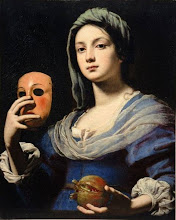
Hypatia as imagined by Raphael

Wednesday, November 17, 2010

Spiral Time

David Pearson is a plastic surgeon who enjoys using Photoshop to distort clock faces into spirals.
There's something a bit worrying about a plastic surgeon who likes distorting things with Photoshop!

The Left Brain as Narrator/Interpreter

"We are our narratives" has become a popular slogan. "We" refers to our selves, in the full-blooded person-constituting sense. "Narratives" refers to the stories we tell about our selves and our exploits in settings as trivial as cocktail parties and as serious as intimate discussions with loved ones. We express some in speech. Others we tell silently to ourselves, in that constant little inner voice. The full collection of one's internal and external narratives generates the self we are intimately acquainted with. Our narrative selves continually unfold.


State-of-the-art neuro-imaging and cognitive neuropsychology both uphold the idea that we create our "selves" through narrative. Based on a half-century's research on "split-brain" patients, neuroscientist Michael Gazzaniga argues that the human brain's left hemisphere is specialised for intelligent behaviour and hypothesis formation. It also possesses the unique capacity to interpret - that is, narrate - behaviours and emotional states initiated by either hemisphere. Not surprisingly, the left hemisphere is also the language hemisphere, with specialised cortical regions for producing, interpreting and understanding speech. It is also the hemisphere that produces narratives.


Gazzaniga also thinks that this left-hemisphere "interpreter" creates the unified feeling of an autobiographical, personal, unique self. "The interpreter sustains a running narrative of our actions, emotions, thoughts, and dreams. The interpreter is the glue that keeps our story unified, and creates our sense of being a coherent, rational agent. To our bag of individual instincts it brings theories about our lives. These narratives of our past behaviour seep into our awareness and give us an autobiography," he writes. The language areas of the left hemisphere are well placed to carry out these tasks. 

Full article a
New Scientist

Shri Mataji Nirmala Devi has identified the left hemisphere of the brain as the area of the subtle body in which the ahamkara (ego) accumulates.


Which comes first, the chicken or the egg? The narrator or the ego?


Drawing Hands is a lithograph by the Dutch artist M. C. Escher first printed in January 1948. It depicts a sheet of paper out of which rise, from wrists that remain flat on the page, two hands, facing each other and in the paradoxical act of drawing one another into existence. Although Escher used paradoxes in his works often, this is one of the most obvious examples.

The lithograph may signify mutual constitution; that is, the principle of one entity being formed by the other and vice versa (e.g., the state vs. the demos, predator–prey co-evolution, the subject and objects, "chicken or the egg?", agency-structure).

It is referenced in the book Gödel, Escher, Bach by Douglas Hofstadter, who calls it an example of a strange loop.

Monday, November 15, 2010

Gibran Exhibition in Sydney


A few days ago, for no particular reason, I suddenly thought about the Lebanese poet/painter/philosopher, Kahlil Gibran (a Lebanese friend once told me his surname is pronounced with a soft 'g' in Lebanon, and with a hard 'g' in other parts of the Arabic speaking world). His work had inspired me in my early twenties but I had forgotten about it since then. Now I had a renewed desire to study his paintings closely. When I thought about it I felt that cool, refreshing goose-bump feeling of something serendipitous working out in mysterious ways. To my knowledge his work is not in the collection of any Australian Art Gallery, and the reproductions online are not of the best quality, so it didn't seem very likely "my" wish would be fulfilled. 
A couple of days later a friend emailed to let me know about an upcoming exhibition on his work, right here in Sydney where I live!


Kahlil Gibran: The Prophet, The Artist, The Man

Open:
4 December 2010 – 20 February 2011
Venue:
Dixson Galleries, Mitchell Library
This exhibition will introduce audiences to Kahlil Gibran. While many Australians of the baby boomer generation have read The Prophet or heard of Gibran, few know about his life or artworks.

Gibran left 
Lebanon in 1895 at the age of 12 with his mother and three siblings for a better life in America. Settling in Boston, his early artistic talent was noticed by pictorial photographer F Holland Day of the Boston avant-garde. Gibran gradually developed into a romantic who read widely and drew compulsively.

This exhibition provides an overview of Gibran’s artistic output, featuring oil paintings, works of art on paper — including the original watercolours used as illustrations in the first edition of The Prophet — and writings selected from Gibran’s personal collection at the Gibran Museum in Bsharri, North Lebanon.
 

Thursday, November 11, 2010

Kahlil Gibran on the Self


Knowledge of the self is the mother of all knowledge. So it is incumbent on me to know my self, to know it completely, to know its minutiae, its characteristics, its subtleties, and its very atoms.


I existed from all eternity and, behold, I am here; and I shall exist till the end of time, for my being has no end. 


Saturday, November 06, 2010

Ran


The film Ran (chaos), by the great Japanese director Akira Kurosawa, is a retelling of Shakespeare's King Lear but introduces original elements such as the ruthless hi-brow Lady Kaede, whose thirst for revenge plunges the world around her into strife and mayhem.

The story world first begins to descend into chaos when the autocratic warlord in charge decides to abdicate power to his cruel and power-hungry older children. Blinded by ego, he rewards their flattery and exiles those who try to show him the truth, including his youngest child.

King Lear and Ran have both been seen as nihilistic because the chaos and ensuing suffering envelops good and bad characters indiscriminately. However, if seen as a tale of Self-realisation through the deflation of ego, the suffering is not without purpose, and the end is not entirely tragic.

Perhaps the most poignantly tragic figure in Ran is the young lord Tsurumaru, whose family is destroyed when the warlord burns down their castle. Eventually he loses his surviving sister, Lady Sué, a devout Buddhist who is able to forgive the warlord for the ruin of her family.

The film ends with a shot of Tsurumaru, blind and alone on top of the ruined castle, the only survivor of the film's events. Stumbling on the precipice he loses the icon of Amida Buddha his sister has given him for spiritual comfort. Even the gods have abandoned him it seems. Yet, in the often painful stripping away of externals, the Self remains unchanged, here symbolised by the radiant Enlightened One, the witness of the world's endless flux.

Tuesday, November 02, 2010

The Sacred Feminine: Mary Magdalene

Mary Magdalene, Attributed to the Master of the Mansi Magdalene (Dutch)


The idea that Mary Magdalene was a fallen woman is a falsehood invented by medieval clerics who wanted to make her into an ideal of the penitent sinner, and so had to turn her life before meeting Christ into something sinful.
She was in fact an incarnation of the Purity of the Divine Feminine, which makes the slurs on her character an even greater wrong.


Mary Magdalene is referred to in early Christian writings as "the apostle to the apostles." In apocryphal texts, she is portrayed as a visionary and leader of the early movement, who was loved by Jesus more than the other disciples.


She is often depicted opening a vessel of ointment (which suggests the vessel of the Spirit, the Kundalini) She is also sometimes shown meditating in the wilderness with a skull in one hand, symbolising the renunciation of the body. These depictions are reminiscent of Indian paintings of Shri Mahakali, the renunciant aspect of the Goddess.


The name Mary occurs in 51 passages of the New Testament. There are several people named Mary in the Gospels. There also are several unnamed women who seem to share characteristics with Mary Magdalene. At different times in history, Mary Magdalene has been confused or misidentified with almost every woman in the four Gospels, except the mother of Jesus. "The idea that this Mary was 'the woman who was a sinner,' or that she was unchaste, is altogether groundless." There is no scriptural or historical evidence that Mary’s relationship with Jesus was anything other than that of a disciple to her teacher, definitely not a lover or wife. Although in the past she has suffered from a case of mistaken identity, Mary Magdalene was never reviled, demeaned or dismissed.
-Wikipedia
Here's a link to an apocryphal text mentioning three Marys in the circle of Christ: Sahaj-A-Z

Thursday, October 28, 2010

Tradition

"Tradition is not the worship of ashes, but the preservation of fire." - Gustav Mahler

People often use the word 'traditional' to lend weight to the ideas or products they are trying to sell. As Richard Dawkins points out in his critique of alternative medical practices which claim to be based on 'traditional' medicine: just because an idea is old doesn't mean it's right.

But there's also the point that things made, or thoughts inspired, by the heart, the abode of the Self, tend to last over time. Time exposes the flaws in works which may initially appear original but are actually based on ego and conditionings. Over time, egoistic things appear idiosyncratic and ugly; things produced by conditioning appear old-fashioned or derivative.


Tuesday, October 19, 2010

Reality


Reality is simply the loss of ego.
Destroy the ego by seeking its identity. 
Because the ego is not a real entity 
it will automatically vanish 
and reality will shine forth by itself.


- Sri Ramana Maharshi


"it is very important to understand that Raghwindra Swami was in this area, and he did a lot of work, and now the time has come to complete his work; also Ramana Maharshi. They didn't know how to explain, so they took to mauna (silence)."
- Shri Mataji Nirmala Devi, Madras, India, 1991


Wikipedia entry on Raghavendra_Swami

Tuesday, October 12, 2010

Art Find of the Century


A renaissance painting, believed by art experts to be an original by Michelangelo, has been discovered behind a sofa. It depicts the Virgin Mary and Christ in a Pieta scene. In medieval versions, the Virgin is shown to the side of, and below the figure of Jesus, but Michelangelo places Her centrally. Read the news article.

Wednesday, September 29, 2010

Goddess of the Mountain

Detail, Allegory of Chastity, Hans Memling, Nederlandish, 15th century.


The Hindu goddess Parvati is the wife of Shiva, the personification of the Eternal Self. Parvata is one of the Sanskrit words for "mountain"; "Parvati" translates to "She of the mountains" and refers to Parvati being born the daughter of Himavan, lord of the mountains and the personification of the Himalayas. Shri Parvati is also called Gauri, meaning "of white or golden complexion". Gauri Mata (Mother Gauri) is the goddess of purity and chastity, and a benevolent aspect of Devi (Goddess); the 'brilliant'. Another form taken by Parvati, is the warrior goddess Durga, whose name means "inaccessible", or "fortress'.

Thursday, September 23, 2010

The Veil of Self


According to Plutarch, the Egyptian temple of the goddess Neith bore the inscription:

I am All That Has Been, That Is, and That Will Be. 
No mortal has yet been able to lift the veil that covers Me.


There was one who arrived there.
He lifted the veil of the goddess.
But what did he see?
Wonder above wonder,
he saw himself.

Hymn to Isis

O Wealth-giver,
Queen of the Gods,
Lady Hermouthis,
Omnipotent
Good Fortune,
Greatly Renowned Isis,
Exalted Deity,
Highest Discoverer of all life.

Many are the miracles You have performed so that mankind could exist,
and morality be established for all.
You taught us customs so that justice might in some measure prevail,
You taught us skills so that human life might be comfortable,
And You found the blossoms that produce nourishing fruit.

Because of You heaven and the whole earth have their being,
And the gusts of the winds, and the sun with its sweet light.
By Your power the channels of the Nile are filled, every one,
At the harvest season, and its turbulent water is poured out
On the whole land so that produce may be unfailing.

All mortals who live on the boundless earth:
Thracians, Greeks and Barbarians,
Express Your fair Name, a Name greatly honored among all,
Each speaks in his own language, in his own land.
The Syrians call You: Astarte, Artemis, Nanaia,
The Lycian tribes call You: Leto, the Lady,
The Thracians also name You as Mother of the gods,
And the Greeks (call You) Hera of the Great Throne, Aphrodite,
Hestia the goodly, Rheia and Demeter.
But the Egyptians call You ‘Thiouis’ (because they know) that You, being One, are all the goddesses invoked by the races of men.

Mighty One, I shall not cease to compose hymns to Your great Power,
Deathless Saviour, many-named, mightiest Isis,
Saving from war, cities and all their citizens:
Men, their wives, possessions, and children.
Those who are bound fast in prison, in the power of death,
Those who as are in pain through long, anguished, sleepless nights,
All who are wanderers in a foreign land,
Those who sail on the Ocean in winter,
When men may be destroyed, and their ships wrecked and sunk.
All of these are saved if they pray that You be present to help.

Hear my prayers, O One whose Name has great Power;
Prove Yourself merciful to me, and free me from all distress.

Isidorus, c 100 BCE

Wednesday, September 15, 2010

Anahita


A 4th century BC depiction of the Iranian goddess Anahita, radiant and mounted on a lion, being worshipped by Artaxerxes II. She was an important deity in the Zoroastrian religion of ancient Persia, responsible for fertility but also skilled in the arts of war. A virgin goddess, Her name means "the immaculate one". 
The Indian goddess, Shri Devi, also rides on a lion or tiger and is indomitable in combat.

Thursday, September 02, 2010

"Creation Delights in the Recognition of Itself"

At the end of Huston Smith's autobiography, Tales of Wonder, he describes an experience his friend Ann Jauregui had as a young girl in Michigan:

In summer she would lie on a wooden raft anchored in the bay, listening to the the waters lapping, drowsy in the warm sunshine. The warm day, the clear northern light, and the water's gentle motion together worked a semi-hypnotic effect.
Then suddenly Ann would snap alert and feel intensely alive, or rather that everything was alive and that she was part of it. The rocks, the water itself - everything seemed pulsating with a kind of energy. She found she put questions to the experience. 'What is my role in all this,' she whispered. 'Show me.'
The rocks, the trees, the water - all in silent chorus 'answered' - not in words, of course - that the wanting to know, just that, was her part in the pulsating landscape.
'Creation delights in the recognition of itself', is how she would later put it.

Inquiry (called vichara in Sanskrit, the language of yoga) is the posing of questions to the Self/Spirit. It is an initial step on the way into Self-realisation or Self-recognition. 
Shri Mataji Nirmala Devi recommends asking the simple question: 'am I the Spirit?'
As meditation deepens, there is less need for Self-inquiry (atmavichara) - at least in words - and the thoughtless awareness state of nirvichara (without inquiry) is established.


Monday, August 16, 2010

Self as Universe

The little space within the heart is as great as a vast universe.
The heavens and the earth are there, and the sun,
and the moon and the stars, fire, lightning and winds are there,
and all that now is, and all that is not:
for the whole universe is the Self and the Self dwells within the heart.

- The Chandogya Upanishad