Showing posts with label illusion. Show all posts

Tuesday, February 16, 2010

Maya


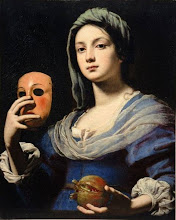
This is Maya (Illusion).
She has been intentionally created.
Without her, the attention would not have developed.
You should not be afraid of Maya
and should recognize Her
so that She will illuminate your path.
A cloud hides the sun and also makes it seen.
In the same way, once the Maya is identified,
she moves aside and the sun is seen.
The sun is always there,
but what is the purpose of the cloud?
Because of the cloud, you have an urge to see the sun,
which shines for a moment and again hides somewhere.

-HH Shri Mataji Nirmala Devi


From the experience of bliss for a long time, there arose in the Supreme Self a certain state like deep sleep. From that state Maya (the illusive power of the Supreme Self) was born, just as a dream arises in sleep. This Maya is without the characteristics of (or different from) Reality or unreality, without beginning, and dependent on the Reality that is the Supreme Self. She, who is of the form of the Three Gunas (the qualities or energies of Nature), brings forth the Universe with all its animate and inanimate things.
-Shri Shankaracharya (probably 788–820 CE)

Wednesday, June 10, 2009

Existence

"Existence is illusory and it is eternal."
-Fyodor Dostoyevsky

"Reality is merely an illusion, albeit a very persistent one."
-Albert Einstein

To the universal Self, the world appears as a play or an illusion. But for human beings this is not the case.

The subtitle of this blog sounds like a joke, but it's actually quite serious: philosophers do not agree on what is meant by the word 'existence'. It begs the question: If they can't agree on something as fundamental as that, what could they ever agree on?
The Vedic Hindu idea of Brahman, pure existence, or a universal Self, is usually classified as 'pantheism'; however, a more accurate label would be 'panentheism', since even deity emerges from Brahman. Pantheism has been generally despised by Western thinkers, partly because of an historical contempt for the beliefs of traditional peoples such as the American Indians.
Many ancient cultures such as Vedic, Native American civilizations share similar views on omnipresent nature; the ancient Greeks and Rome did not worship an omnipresent being. A form of omnipresent deity arises from a worldview that does not share ideas with mono-local deity cultures. Some omnipresent religions see the whole of Existence as a manifestation of the deity. There are two predominant viewpoints here: pantheism, deity is the summation of Existence; and panentheism, deity is an emergent property of Existence. The first is closest to the Native Americans' worldview; the latter resembles the Vedic outlook.
-Wikipedia

Friday, January 26, 2007

Shakespearean non-dualism


"We are such things as dreams are made on."*
-William Shakespeare, The Tempest

Much about the character of Prospero in The Tempest persuades us that he is the closest thing in the plays to autobiography. Generally it is inappropriate to read a fictional character's ideas and opinions as being those of its author, but here there is a case for doing so. For example, both Prospero and Shakespeare renounce 'art'. Prospero gave up illusionistic magic, and The Tempest was the Bard's last play. So when Prospero speculates about the nature of reality, it is tempting to read these thoughts as Shakespeare's own. Shakespeare is like an Avadhuta - a sage dedicated to dispelling human illusions such as 'I'-consciousness. It could be objected that if 'I' and 'you' are no more than dreamstuff, then love between two people is meaningless. Miranda and Ferdinand ought to call the whole thing off. But to the non-dualist Prospero real love is a state in which there is no other ('Ananya' in Sanskrit). This is how it is possible for him to forgive his evil brother Antonio - there is no other to forgive or not forgive.
.
"Avadhuta (अवधूत) is a term from the Dharmic Religions of India referring to a somewhat eccentric type of mystic or saint who has risen above bodily-consciousness, duality, and worldly concerns and acts without consideration for standard social etiquette. Such personalities are considered to be free from the consciousness of the ego, and to 'roam free like a child' over the face of the earth. An avadhut does not identify with their body or mind. Such a person is said to be pure consciousness in human form. Avadhuts play a significant role in the history of a number of Yoga, Vedanta and Bhakti traditions."
-Wikipedia

*Sometimes this line is rendered as: "...dreams are made of"