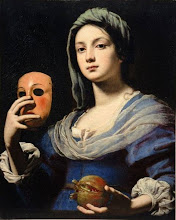
Your own Self-Realisation
is the greatest service you can
render the world.
Your duty is to be, and not to be this or that. "I am that I am" sums up the whole truth...
"I-I" is the Self. "I am this" is the ego. When the "I" is kept up as the "I" only, it is the Self. When it flies off at a tangent and says "I am this or that, I am such and such," - it is the ego.
-The Sage of Arunchala
Wednesday, January 06, 2010


Monday, January 04, 2010
Advaita in Sikhism

- Shri Guru Nanaka, Siree Raag 24
Thursday, December 31, 2009
The Self as Centre

"I began to understand that the goal of psychic development is the self. There is no linear evolution; there is only a circumambulation of the self. Uniform development exists, at most, at the beginning; later, everything points toward the centre. This insight gave me stability, and gradually my inner peace returned."
-Carl Jung, Memories, Dreams, ReflectionsPradakshina (circumambulation)
"One of the customary aspects of going to a temple is the practice of going around the deity or the sanctum sanctorum. This is called pradakshina. Typically, pradakshina is done after the completion of traditional worship (pooja) and after paying homage to the deity. We cannot draw a circle without a center point. The Lord is the center, source and essence of our lives. We acknowledge this by performing pradakshina. Also, every point on the circumference of a circle is equidistant from the center. This means that wherever or whoever we may be, we are equally close to the Lord. His grace flows towards us without partiality. The pradakshina is done clockwise. Indeed, the word pradakshina means “moving rightward” in Sanskrit. The reason is, not as someone said, to avoid a traffic jam (Although, it certainly helps!). As we do pradakshina, the Lord is always on our right. Hindus traditionally associate right side with auspiciousness. So as we circumambulate the deity, we remind ourselves to lead an auspicious life of righteousness, with the Lord who is the indispensable source of help and strength, as our guide - “the right hand”. Often, devotees additionally circumambulate around themselves (turning in place) again, thereby recognizing the presence of divinity in themselves."
Source: Marg, Vol 2, No. 4 (July-August 2006)
Wednesday, December 30, 2009
The Spirituality of Sound
To us, music can be a spiritual discipline on the path to self-realisation, for we follow the traditional teaching that sound is God - Nada Brahma: By this process individual consciousness can be elevated to a realm of awareness where the revelation of the true meaning of the universe - its eternal and unchanging essence - can be joyfully experienced. Our ragas are the vehicles by which this essence can be perceived.
The ancient Vedic scriptures teach that there are two types of sound. One is a vibration of ether, the upper or purer air near the celestral realm. This sound is called Anahata Nad or unstruck sound. Sought after by great enlightened yogis, it can only be heard by them. The sound of the universe is the vibration thought by some to be like the music of the spheres that the Greek Pythagoras described in the 6th century B.C. The other sound Ahata Nad or struck sound, is the vibration of air in the lower atmosphere closer to the earth. It is any sound that we hear in nature or man-made sounds, musical and non-musical.
-Ravi Shankar
Tuesday, December 29, 2009
Avatar

Whenever righteousness wanes
and unrighteousness increases
I send myself forth. In order to protect the good
and punish the wicked,
In order to make a firm foundation
for righteousness,
I come into being age after age.
- Bhagavad Gita
In Hinduism, avatar (or avatara) is a word used to describe the descent of a deity into manifest form. The term is derived from ava (down) and tṝ (to cross), and has come to signify the being who descends rather than the act of descent - the original meaning. Avatars are aspects of the Divine Self who incarnate for a specific purpose. There are many avatars of the Hindu Goddess (Shri Devi or Shri Shakti). The aspect of the Divine Self as guru, or teacher, also incarnates. Perhaps most of the Hindu avatars are incarnations of the deity Shri Vishnu, who is the aspect of the Hindu Trinity responsible for maintaining the universe and its laws. The other two aspects of the Hindu Trinity are Shri Brahma (creation) and Shri Shiva (dissolution). Avatars of Shri Brahma are very rare. Shri Shiva is thought not to have ever incarnated, as He represents the unmanifest Self. There are, however some great rishis and saints who are considered to be partial incarnations of Lord Shiva, for example Shri Ramana Maharshi (no connection to TM). Some of the aspects of Shri Shiva are believed to have incarnated, such as Shri Bhairava. The Shiva Puranas tell of a Shiva avatar in the form of a bird-lion, called S(h)arabha, who incarnated in order to quell the exessive rage of Shri Narasimha, the man-lion avatar of Shri Vishnu, after He killed the demon Hiranyakashipu. In some versions of the myth, a powerful and wrathful bird, with two heads, emerged from Narasimha and fought with Sharabha for many days until Shri Narasimha's anger was satisfied. The double-headed bird can be found on the emblem of Karnataka state in India, and also in European/Russian heraldry and Amerindian tradition.
 Double-headed eagle of the Russian royal emblem.
Saturday, December 26, 2009
Christmas
Ego sum Lux Mundi
"I am the Light of the World"
-Jesus
Long ago, I used to baulk at the notion that early Christians would have taken pre-Christian symbolism into account, until I went to Europe and saw churches built on pagan sacred sites, and temples recycled as basillicas. Early Christians believed that certain pre-Christian, pagan prophets and sybils had been given revelations which supported Christianity. This is harder for present day Christians to accept. Many of them seeing such symbolism as a watering down or contamination, rather than a reinforcement, of their faith.
 Michelangelo,
The Libyan Sybil,
Sistine Chapel.
"I am the Light of the World"
-Jesus
The nativity of Jesus did not occur in December. It is appropriate that The Light of the World incarnated at the time of Diwali, the Festival of Lights. The date of Diwali is set by the Hindu lunar calendar, which varies from year to year. It usually falls in October or November.
However, late December also has significance for this incarnation of light, as it is the time of the mid-winter solstice, after which the days begin to lengthen in the Northern Hemisphere. Early Christians admitted that they had no idea when Jesus was born. It is likely that they fixed the date of Christmas at the midwinter solstice because of it's symbolic association with the resurrection of the sun's light, a time of rejoicing for those living in chilly Northern climes.
However, late December also has significance for this incarnation of light, as it is the time of the mid-winter solstice, after which the days begin to lengthen in the Northern Hemisphere. Early Christians admitted that they had no idea when Jesus was born. It is likely that they fixed the date of Christmas at the midwinter solstice because of it's symbolic association with the resurrection of the sun's light, a time of rejoicing for those living in chilly Northern climes.
Long ago, I used to baulk at the notion that early Christians would have taken pre-Christian symbolism into account, until I went to Europe and saw churches built on pagan sacred sites, and temples recycled as basillicas. Early Christians believed that certain pre-Christian, pagan prophets and sybils had been given revelations which supported Christianity. This is harder for present day Christians to accept. Many of them seeing such symbolism as a watering down or contamination, rather than a reinforcement, of their faith.
Light is the phase of vibration associated with the Agnya (Brow) Chakra, the subtle psycho-spiritual centre located in the optic area of the brain.

The Libyan Sybil,
Sistine Chapel.
Maybe we antipodeans should celebrate Christmas in our midwinter. This already happens in the Blue Mountains not far from Sydney. It sometimes snows there in winter, so there's even the chance of getting a traditional European white Christmas. The idea for "Christmas in July" blossomed in 1980 as snow began to fall on a cold winter's night at the Mountain Heritage Hotel, Katoomba. A small group of Irish visitors had come to The Blue Mountains to enjoy the clear winter climate that they were accustomed to back in Ireland - they commented that "Celebrating Christmas in Australia during the heat of summer just didn't feel quite the same". The host and owner of the Mountain Heritage offered to re-create for his Irish guests, a festive 'Winter Christmas' atmosphere with all the trimmings - frosted windows, Christmas feasts of turkey, hams, mince pies and steaming plum puddings, and choristers joining together singing the joys of the festive season. Plus, of course, a snowman. This tradition has become known as "Yulefest" and lives on throughout the Blue Mountains in the winter months of June, July and August.
Monday, December 21, 2009
Stillness

"Within you there is a stillness and a sanctuary to which you can retreat at any time and be yourself."
"Meditate. Live purely. Be quiet. Do your work with mastery. Like the moon, come out from behind the clouds! Shine."
-The Buddha
Saturday, December 12, 2009
At the Art Gallery of NSW

An exhibition currently at the AGNSW, Garden and Cosmos, includes paintings inspired by the Nath tradition of yoga. The painting above, The Equivalence Of Self and Universe, illustrates the Nath non-dual concept that the Self and Universe are one and the same. The painting below depicts the inner subtle body with its chakras.

Tuesday, December 08, 2009
Silence
 After her conversion to Christianity, the French Jewish writer Simone Weil found that she could use the Lord's Prayer to enter into a state of thoughtless awareness, mental silence or meditation.
“The effect of this practice is extraordinary and surprises me every time, for, although I experience it each day, it exceeds my expectation at each repetition. At times the very first words tear my thoughts from my body and transport it to a place outside space where there is neither perspective nor point of view. The infinity of the ordinary expanses of perception is replaced by an infinity to the second or sometimes the third degree. At the same time, filling every part of this infinity of infinity, there is silence, a silence which is not an absence of sound but which is the object of a positive sensation, more positive than that of sound. Noises, if there are any, only reach me after crossing this silence.”
- Simone Weil, Waiting on God.
Information and Reality
"In the history of physics, we have learned that there are distinctions that we really should not make, such as between space and time... It could very well be that the distinction we make between information and reality is wrong. This is not saying that everything is just information. But it is saying that we need a new concept that encompasses or includes both."
- Dr. Anton Zeilinger Zeilinger is first ever recipient of the Isaac Newton Medal for his pioneering contributions to physics as the head of one of the most successful quantum optics groups in the world. Over the past two decades, he and his colleagues have done as much as anyone else to test quantum mechanics. And since its inception more than 80 years ago, quantum mechanics has possibly weathered more scrutiny than any theory ever devised. Quantum mechanics appears correct, and now Zeilinger and his group have started experimenting with what the theory means.
Some theories of consciousness speculate that consciousness, perhaps even selfhood, is an information state.
Perhaps the distinction between Selfhood and reality is also a false distinction.
Sunday, November 22, 2009
St Michael

Jeronimus
Oil on canvas,
12.5 x 12.5 cm
St Michael is an aspect of the Self, who drives away negativity from the Ida Nadi (left/lunar channel of the subtle body). Those suffering from mental problems, lethargy, or chronic disease can invoke His aid. In the work by Raphael (a detail of which inspired this painting) St Michael is depicted slaying a dragon, representing the impure desires that can affect the left side.
Tuesday, November 10, 2009
Kundalini
Kundalini is the Mother of the world, who illumines the self
and gives shade to the sprouted seed of the universe. It is the embodiment of the formless Brahman,
the cask of Lord Shiva,
the main spring of the sacred syllable Om.
- Shri Jnaneshwara (Dnyaneshwara. also known as Jñanadeva) (1275-1296), Jnaneshwari (Dnyaneshwari)

William Blake, Beatrice Addressing Dante
Monday, November 09, 2009
Things

Oil painting by Jeffrey T Larson
"Everywhere we seek the Absolute, and always we find only things."
"Every beloved object is the center point of a paradise."
-Novalis
The Self is not a thing.
The Self is not an object,
The Self is pure Subject,
yet it is also things that are loved.
If anything in the world of things is the object of love,
it is the Self.
yet it is also things that are loved.
If anything in the world of things is the object of love,
it is the Self.
Monday, November 02, 2009
Julian of Norwich
 The Anchoress known as Julian of Norwich (born in late 1342) is thought of as one of the greatest English mystics. Virtually nothing is known about her aside from what she writes in her remarkable book, but even there she reveals little about herself, preferring instead to talk about her “courteous” God. In her work (considered to be the first book written by a woman in English), Julian recounts an amazing series of visions she had while suffering from a life-threatening illness; as she reflects on the meaning of her visions, she reveals a profound level of mystical wisdom and insight that, over six hundred years later, remains on the cutting edge of Christian theology. Today, Julian is best known for her optimism; she is most-often quoted for saying “All shall be well, and all shall be well, and all manner of things shall be well” (which was Christ’s response to her when she wondered about why sin had to exist). A lesser known but equally lovely quote: “The fullness of joy is to behold God in all.” Julian is also celebrated for naming both God and Christ as “Mother.” More than a cute theological ploy, she articulates a fully-formed spirituality of the motherhood of God, yet always within the parameters of an orthodox appreciation of the Christian faith.
 The deep Wisdom of the Trinity is our Mother
in whom we are all enclosed
I beheld the action of all the blessed Trinity.
In that sight I saw and understood these three aspects:
the aspect of the Fatherhood,
the aspect of the Motherhood,
and the aspect of the Lordhood,
in one God.
- The Revelations of Divine Love of Blessed Julian of Norwich
Tuesday, October 20, 2009
Slow Art
“What we need more of is slow art. Art that holds time as a vase holds water. Art that grows out of modes of perception and making whose skill and doggedness make you think and feel, art that isn’t merely sensational, that doesn’t get its message across in ten seconds, that isn’t falsely iconic, that hooks into something deep-running in our natures… art that is the very opposite of mass media.”
Robert Hughes, The New Shock of the New
Monday, October 19, 2009
WHO launches war on alcohol
"Humanity's relationship with alcohol has never been easy. Now it is about to undergo as great a change as our attitude to tobacco, which has seen smoking plummet from the height of cool to the lowest of unpleasant habits. That at least is the hope of the World Health Organization, which, between now and January, will be honing its draft of the first global strategy on reducing health damage from alcohol abuse, the fifth leading cause of premature death and disability worldwide."
"The overall harm caused by alcohol is greater than that caused by LSD or ecstasy, and not far behind cocaine. When society stops thinking of alcohol as as relaxing tipple and regards it as another drug, that will signal the biggest change in thinking of all."
"The overall harm caused by alcohol is greater than that caused by LSD or ecstasy, and not far behind cocaine. When society stops thinking of alcohol as as relaxing tipple and regards it as another drug, that will signal the biggest change in thinking of all."
-New Scientist
Subscribe to:
Posts (Atom)