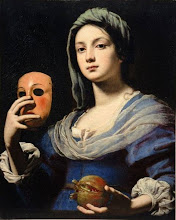
Monday, July 28, 2008

Possessorship of Self

The Goal of Eastern practices is the same as that of Western mysticism: the focus is shifted from the "I" to the Self, from man to God. This means that the "I" disappears in the Self, and man in God. A similar effort is described in the exercitia spiritualia, in which the "personal property", the "I" subjugate to the highest possible degree to the possessorship of Christ.

- Carl Jung

Einstein and God


For a long time there has been a debate about whether or not Einstein believed in God (whatever that word means). Many years ago, when I was a student, I attended a lecture by a famous physicist who had been an associate of Einstein. A Christian student asked him if he knew what Einstein's opinion was on the existence of God. The physicist replied, with a great deal of irritation at what he obviously thought was an irrelevant question, that Einstein did not believe in God. A rather biased recent article in New Scientist magazine came to much the same conclusion. But to say that Einstein did not believe in 'God' is simplistic, and ignors the many statements made by Einstein that evince a deep and lasting conviction that the Universe has a Self. The physicist who gave the lecture was an extremely dry, 'left-brain', individual; probably Einstein felt it was a waste of time sharing his pantheistic ideas about God, or a universal Self, with those who were unable to go beyond very limited definitions. Attempts to categorize his convictions, or to appropriate them for conventional theistic or atheistic purposes, miss their subtlety and their apophatic resonances. (Apophatic: http://en.wikipedia.org/wiki/Negative_theology)
Here's a letter New Scientist published in reply to their article:


The interesting thing about Einstein's take on God and religion is not that he considered god to be impersonal, but that he recognised the vast and intense intelligence inherent in the universe. Perhaps in the first half of the 20th century it was easier to think of personhood as a separate thing to physicality, and to associate the idea of a personal god only with the abuses of that concept perpetuated by those in power. But compartmentalisation has broken down and the disciplines of physics, biology, psychology and philosophy are more integrated than ever before. Just as we ascribe personhood to the complex animated system of energy, mass and chemistry we call the human body, it is not unscientific to ascribe personhood to the universe. Science is at a crucial point, where we are finding that most of the mass in the universe is something we know nothing about and where we can look so closely at subatomic matter that it disappears before our eyes. At the same time, our ability to reconcile ethics with scientific capability is being challenged in many areas, from genetic design to space exploration. This is no time to write off god as an impersonal force of nature, nor to write off our fellow human beings as expendable units. Einstein, genius as he was, may have thrown out the baby (a personal god) with the bath water (abuses of religion), but he didn't get rid of the bath.
- Andy Smith, Ashford, Kent UK

Saturday, July 26, 2008

The Great Forest Teaching


Forest in the highlands of Kerala, South India

Maitreyi was confused about the idea of a Self in which individuality is dissolved. She asked her husband, the sage Yagnavalkya, to clarify. He replied: "As long as the dualism of the mind is operating, one senses and knows things and people as others, but for those who have realised the Self, in which all things are dissolved, who is there to be sensed by whom, who is there to be known by whom? By whom shall the Senser be sensed? By whom shall the Knower be known? The Self is described as not this, not that. It is incomprehensible, for it cannot be grasped by the tongs of dualism."
(Adapted from the Brhadaranyaka Upanishad by Jeronimus )

The Bṛhadāraṇyaka Upanishad (which translates as the Great Forest Teaching) is one of the oldest of the Upanishads (possibly the oldest), dating to approximately the 8th to 7th centuries BCE. It figures as number 10 in the Muktika canon of 108 Upanishads and was notably commented upon by Adi Shankaracharya. T S Eliot based one of his poems on it.

Friday, July 25, 2008

The Intuitive and Rational Mind

The intuitive mind is a sacred gift
And the rational mind is a faithful servant.
We have created a society that honours the servant
And has forgotten the gift
- Albert Einstein


Einstein with Rabindranath Tagore

Thursday, July 17, 2008

New Link

We've created a new blog called
'Images of Lord Ganesha'
(see links)

Saturday, July 12, 2008

Martin Luther King


"Ten thousand fools proclaim themselves into obscurity,
while one wise man forgets himself into immortality"

- Martin Luther King

Wednesday, July 09, 2008

'I' Consciousness

"May our 'I' consciousness fade away"

- Shri Mataji Nirmala Devi
(From a letter in Marathi)

Tuesday, July 08, 2008

Selfhood and Human Rights

We express our own individuality through the word ‘I’. Without an ‘I’, there is no moral freedom, no distinction between good and evil, and thus no politics either. But what exactly is this individuality, which we normally refer to as ‘I’? The ‘I’ must clearly be distinguished from its ‘possessions’. I ‘have’ a body, a gender, and a native language. I experience pleasure and pain. I have memories and ambitions. However, the word ‘I’ makes it clear that I am not all of this – but can place myself as subject in distinction to it. To begin with, then, the word ‘I’ indicates a kind of void, an empty space. This void is identical in all humans – as identical as only two voids can be. In this fact we discover the objective basis for the principle of equal rights, for equality before the law, regardless of any differences people possess. People have differences, but people are equal. However, the ‘I’ is not a ‘no-thing’. Like the ‘superposition of quantum theory, the human ‘I’ is a void full of potential, of expectancy and creative power; it is the emptiness of the moral will, before that moral will has yet brought forth a moral judgement. What lies dormant in the void is the as yet undifferentiated capacity for involvement. The human ‘I’ is nothing other than the manifestation of involvement in the world. And it is precisely involvement that distinguishes freedom from licence. Without involvement, I am as free as an astronaut who alone, and with nothing to hold onto, tumbles slowly around his or her centre of gravity in the weightlessness of space. The astronaut can perform voluntary movements, but cannot affect the position of his or her centre of gravity relative to other objects, because all connection to the surrounding world has been severed. If I do not get involved with other people, even the most exalted deed will not touch me internally; it will leave me ‘disconnected’. Without commitment and involvement, I am not free to change. Only by virtue of my involvement do I change myself through what I do.


Verhulst, J., & Nijeboer, A. (2007). Direct Democracy: Facts and Arguments about the Introduction of Initiative and Referendum. pages 37-38. Democracy International, Brussels.
http://www.democracy-international.org/book-direct-democracy.html

Thanks to John Noyce for sending me this. Check out his blog: http://www.historye.blogspot.com/

It's interesting that the question of selfhood - once left to mystics and philosophers - is now seen as worth inquiry by scientists, and even legislators.

Friday, July 04, 2008

Shri Shankaracharya on the importance of Self-realisation

"Let people quote the Scriptures and sacrifice to the gods,
let them perform rituals and worship the deities,
but there is no Liberation without the realisation of one’s identity with the Self,
no, not even in the lifetime of a hundred Brahmas put together."

- Shri Shankaracharya, Viveka Chudamani (8th Century CE but possibly 1000 years earlier)

Shri Shankaracharya's Viveka Chudamani (which translates as: The Crest Jewel of Discrimination) expounds the significance of Self-Realisation and the ways to attain it, methods of meditation (dhyana) and introspection of the Atman (Self). It concludes with the denial of Pluralism of Self, and the description of the state of Self-Realisation.


A jewel is symbolic of the Non-dual Self,
which is both single and at the same time multifaceted.

Monday, June 30, 2008

Christian Nondualism

Gnostic Christianity is usually understood to be a dualistic movement; however, recent discoveries, including the Gospel of Thomas, have led some scholars to believe that Jesus' original teaching may have been one accurately characterized as nondualism.

The Gospel of Philip, another of the Apocryphal books, also conveys nondualism:
"Light and Darkness, life and death, right and left, are brothers of one another. They are inseparable. Because of this neither are the good good, nor evil evil, nor is life life, nor death death. For this reason each one will dissolve into its earliest origin. But those who are exalted above the world are indissoluble, eternal."

Thursday, June 26, 2008

The Subtle


Navajo sand painting

In Sanskrit, the word for it is sukshma (the 'u' pronounced like the 'oo' in book). It is the unseen anatomy of the Self, and was once a litmus test for great art, before our senses became dulled by empty intellectualism. The sense of subtlety persists more in classical music culture than in the visual arts, where shock value has more or less obliterated it.

People conditioned by religious or intellectual dogma, often react to art or writing that has a subtle dimension, or points to something beyond the gross, branding it "occult". Without Self-realisation it is difficult to discriminate between what is subtle and what is occult, particularly where traditions which may have originated with Self-realised figures have become mixed over the centuries with magic practices (by magic read: forms of gross ritualism aimed at fulfilling desires other than the pure desire for Self-hood)

The term subtle body is a term for the pranic, mental and consciousness bodies considered collectively, and called Sukshma sarira in Sanskrit. According to the traditional teachings of Yoga, human beings are constituted not only by a gross physical form but by a series of energetic psycho-spiritual subtle bodies each of increasing subtlety and metaphysical significance. Derived principally from the Indian spiritual tradition where they were originally conceived as sheaths covering the immortal soul, these concepts spread throughout Asia, as far East as Japan, and may have influenced the mystical aspects of Judaism and Islam. Knowledge of the subtle body reached the West in the late nineteenth century, brought largely by people who had no direct experience of it in meditative practice.

The concept of one or more subtle bodies in human beings is a common philosophical element in diverse spiritual traditions worldwide (it is even found in the Americas, in the lore of the Hopi holy men, which leads to the conclusion that it is a deep and vital knowledge that emerged there from the collective unconscious, independently of other traditions. Though the concept of the subtle body has been tarnished by association with occult tantric practices in more recent times, it is important to have an understanding of the anatomy of one's subtle self in order to be truly well, in the sense of being an integrated whole.

After getting shocking news, a person may put a hand on their heart. When something strikes us as really wrong, we may feel 'sick to the stomach'. These are examples of the fact that awareness is not confined to the brain, but is suffused throughout the body, particularly in the seven major nerve plexuses governing the main organs of the physical body. Over time, yogis in ancient India and Amerindian healers, for example, gained knowledge of the intricacies of the subtle body, beyond the basic reactions mentioned above, and how various emotional or spiritual states correspond to different parts of the body. They achieved this through the purification, concentration and expansion of awareness in meditation.

Art is a step from what is obvious and well-known toward what is arcane and concealed.

Kahlil Gibran

Tuesday, June 24, 2008

The Angels of Creation


The Pre-Raphaelite painter Burne-Jones depicted the angels of the seven days of The Creation.
This became the basis of a stained glass design by his lifelong friend William Morris.
.
.
The Biblical idea of a sevenfold creation reflects the seven chakras of the subtle system, each with its presiding deity or archangel, governing a different aspect of our being.

Burne-Jones liked to show the Kundalini energy emerging from the Sahasrara Chakra at the crown of the head.


The Soul


In Classical Philosophy, there is the idea of the Anima Mundi or World Soul.
The Latin word anima is feminine.
The part of the world where her soul resides, in particular, is in Italy, where one of her sons - Leonardo - magically managed to capture her face.


"There really is only one world soul,
which I for preference call my soul..."
-Wittgenstein, Notebooks 1914-1916

(Wittgenstein uses the terms soul, self, subject, and I interchangeably)

Multiple souls may exist, each unique; however they do not have separate owners. What Wittgenstein was suggesting is that it is the notion of ownership which creates the illusion of a multiplicity of egos.

Friday, June 13, 2008

Black Elk


"The man who is...pure
contains the Universe
in the pocket of his heart."


-Black Elk, a holy man of the Oglala Sioux


Wakan Tanka is the name for "The Great Spirit" in the Sioux tradition. However, its meaning is closer to "Great Mystery", and is typically understood as the power or the sacredness which resides in everything. Wakan Tanka pervades the entire universe, transcending even the gods -
something similar in nature to the Brahman of Hinduism, or the Tao of Lao Tse.
During a vision, in which he found himself looking from the prospect of a mountain top, Black Elk saw the extent of the power of this Universal Being. Self-realisation is the experience of this Universal Being, not of an illusory individualism. It is a process which first requires humility. In egocentric societies, the notion of humility is associated with weakness. To Black Elk, humility is the key to the infinite and invincible strength of Wakan Tanka.

"[The Sun Dancers] also put rabbit skins on their arms and legs, for the rabbit represents humility, because he is quiet and soft and not self-asserting — a quality which we must all possess when we go to the center of the world. This center which is here, but which we know is really everywhere, is Wakan-Tanka."

Monday, June 09, 2008

Samuel Palmer


The Golden City

I recently made a trip to Canberra to see an exhibition of landscape paintings by artists such as Turner, Monet and Constable. This exquisite watercolour painting by the mystic Samuel Palmer, a friend and disciple of William Blake, was a real highlight.

The influence of Blake can be seen in this engraving.

Saturday, May 31, 2008

Kata Tjuta


Painting of The Olgas by the Australian Self-realised artist
John Henshaw

This painting is a depiction of Kata Tjuta (The Olgas), a rock formation near Uluru (Ayers Rock) in Central Australia.
Kata Tjuta is a swyambhu (auspicious, sacred, Self-created formation, or Earth Chakra) and a sacred site to the Australian Aborigines. Shri Mataji Nirmala Devi has identified it as a manifestation of the maternal aspect of the Divine. Hence it is connected to the primordial maternal Kundalini energy. The Kundalini is also associated with the Rainbow Serpent of Aboriginal legend, and the rainbow colours in the painting depict this subtle aspect of the site. The Australian Outback landscape can seem drab compared to the lush environments of Europe or the tropics, but in certain lights one can perceive an amazing iridescence in the greys and ochres of these sacred rocks.