Monday, May 26, 2008

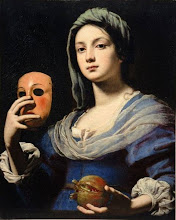
"Ego stops us from understanding where we stand and to know who we really are."
Shri Mataji Nirmala Devi
- Italy, 2008


Gold mask cosmetic treatment

Thursday, May 22, 2008

Ayn Sof

All the great spiritual traditions of the world posit the existence of a single universal Self; though this is often overlooked, or even hidden.

In the mystical aspect of Judaism, there is the notion of the Ayn Sof (or Ein Sof), which literally means "without end" - limitless, inconceivable being. For centuries it was a hidden teaching that the Creator was actually a creation of Ayn Sof (this is similar to the Gnostic idea of the demiurge - a created creator). The Self is thus the creator of the being commonly conceived of as 'God'.

Many monotheists continue the same relationship with their one God that pagan polytheists had with their many gods, cajoling the deity to get what they want, then perhaps rejecting him if he doesn't deliver the goods. Ayn Sof, however, transcends even deity, and there is the idea that one can go beyond a dualistic, business relationship with It.

Fundamentalists and atheists alike are obsessed with the issue of the existence of God. Many sages have suggested that rather than questioning: "Does God exist?", it might be more fruitful to ask: "Who is the one who is asking the question?" All of the great teachers, from the Buddha to Lord Muhammad, have intimated that it is only by realising the Self that one may realise the nature of God.
Isaac the Blind was the medieval Jewish mystic who first used the term Ein Sof. Though he considered Ein Sof to be inaccessible to thought (like the Brahman of Indian Philosophy) he wrote that It may be approached by a mind free of thoughts. This stressing of the importance of mental stillness, making the mind like a cleaned mirror to perfectly reflect the Divine, is common to all the mystical traditions of the world.


Robert Fludd's view of the tree of the sephiroth (Jewish Mysticism)
from Utriusque cosmi historia, 1621.
The ten Sephiroth are emanations from Ayn Sof (the Self).
The tree is depicted growing downwards - this reflects the idea of the subtle body with its chakras, each looking after a different aspect of manifestation, having its roots in the Sahasrara at the crown of the head. The material world emerges from the spiritual realm. Western science assumes that selfhood and consciousness emerges from matter, Eastern philosophy often reverses this - the world emerges from the Self.
.

In India, the Creator, Lord Brahma, has only a handful of temples dedicated exclusively to Him, while the other two members of the Hindu trinity (Shri Vishnu and His various aspects, and Shri Shiva) have countless. The reason often given for this anomaly is that, in Hindu mythology, a curse was once laid on Him that He would not be worshipped. This myth is perhaps a metaphor for the Hindu idea of rejecting the created world in favour of the uncreated Self.

Tuesday, May 06, 2008

Self-realisation


Prophecy. Engraving from a book by the English mage Robert Fludd

The experience of Self-realisation is suggested in Christian cultures as either a flame-like energy or a baptism with water at the crown of the head - the Sahasrara Chakra.
The term Self-realisation is the equivalent of Sanskrit Atmasakshatkar or Atmabodha.
Atma means the Self. Sakshatkar refers to the experience of knowing that one is truly that. Bodha refers to knowledge; not knowledge gained from reading books, but experience of the Self directly on the central nervous system, particularly at the crown of the head.
The word gnosis has a similar meaning: knowledge through direct experience - not intellectual belief - that one is the universal Self.

Monday, May 05, 2008

Novalis on the Universal Self


Robert Fludd, The Great Chain of Being


"We dream of travels throughout the universe:
is not the universe within us?
We do not know the depths of our spirit.
The mysterious path leads within.
In us, or nowhere, lies eternity with its worlds,
the past and the future."

"I was still blind, but twinkling stars did dance
Throughout my being's limitless expanse,
Nothing had yet drawn close,
only at distant stages I found myself,
a mere suggestion sensed in past and future ages."

"The first step is to look within,
the discriminating contemplation of the self.
He who remains at this point only half develops.
The second step must be a telling look without,
independent, sustained contemplation of the external world."

[the Self and Universe are one and the same.
Contemplation of world is contemplation of Self;
However, one must first realise the Self through inner contemplation ]

"There is but one temple in the Universe
and that is the Body of Man."

Friday, May 02, 2008

Fragrance of the Self


Without a true teacher
man remains ignorant and lost

A lion cub became lost
and wandered into a shepherd’s flock.
He was adopted and raised by the shepherd.
He played and grazed with the sheep,
never realizing his true nature.

A lion came from the forest.
Seeing this fully grown sheep-lion,
he was amazed and outraged.
He caught him firmly and at once explained the truth.
When the sheep-lion saw what he had become,
he smiled.

The fragrance of musk
comes from the musk deer
but the foolish animal runs all through the forest
searching for the source of the fragrance.
If only he could look within,
he would find the fragrance within himself.

Says Kabir – My being is centered,
in between ‘above’ and ‘below’,
the splendorous experience is indescribable.
Listen, oh Aspirant!
Turn within and find your Self.

-Kabir. Contemporary of Ravidas (see earlier post)

Sahasrara


Do not go to the garden of flowers!
O Friend! go not there;
In your body is the garden of flowers.
Take your seat on the thousand petals of the lotus,
And there gaze on Infinite Beauty.
- Sant Kabir

The Garden of Flowers within refers to the Subtle Body with it's flower-like Chakras. The Lotus of a Thousand Petals is the Sahasrara Chakra at the crown of the head, where the yogi achieves Self-realisation. In meditation, this is the best place to put one's attention, as it is above the ego and superego (the mind).

Ravidas

Guru Ravidas (or Raidas) (1398? - 1448?) is believed to be a younger contemporary of Sant Kabir. His occupation involved dealing with leather - dead animal matter - which made him a so-called 'untouchable', yet today he is revered - as is Kabir - by Hindus as well as Muslims, and his poetry is included in the Sikh Holy Book, the Guru Granth Sahib.

Here is one of his devotional poems:

When I existed,
You did not.
Now You exist
and I do not:

As a storm lifts waves from water -
still they are water
within water.

O Madho,
how can we describe this illusion?
What we believe in
does not exist.

A mighty king sleeps on his throne
and in his dream becomes a beggar.
Seeing his kingdom vanish before him
he greatly mourns -
such is our condition.

Like the tale of the serpent and the rope -
I know a little of the secret.
Seeing many bracelets
we think gold has many forms -
but it is always forever gold.

In all things exists the Lord,
assuming countless shapes;
in each pore He plays and sports.
Ravidas says: He is nearer than my hand.
All that comes to pass is by His will alone.


Enormous copy of the Sri Guru Granth Sahib

Wednesday, April 30, 2008

Jodha Akbar


Hritik Roshan? as The Mughal Emperor Akbar, and Aishwarya Rai as Jodha Bai.
Stills from the Hindi movie Jodha Akbar.


Though a Muslim Emperor, Akbar (the Great), who was extremely tolerant for his time, wanted to unite the various faiths and peoples within his extensive empire. He married a Hindu princess, Jodha Bai, and invited Sunni's, Shias, Christians, Jains and Hindus to debate religious issues at his court. After hearing their arguments, he decided that no one religion has a monopoly on truth. Then he created his own syncretist religion.


Akbar was a devotee of the Sufi Saint Salim Chisti, one of a long line of pirs in a branch of Sufism particularly renowned for it's tolerance, and emphasis on love as the true essence of religion. To this day, both Muslims and Hindus worship at many of the Chisti Shrines.


Unable to produce a male heir, Akbar walked barefoot to meet with the saint to ask for a blessing so that he could have a son. Akbar subsequently had three sons. Later he built his palace of Fatehpur Sikri, and a beautiful marble tomb for Salim Chisti, on the site of the saint's encampment.
Here is a link to a beautiful sufi song:
http://sahajapower.wordpress.com/2008/05/18/o-saint-khwaja-reside-in-my-heart/

Akbar was an exceptional patron of the arts. Under his reign, Indian miniature painting reached a high point, combining Islamic decorative bravura with Hindu genius for combining rich, bright colours.


Akbar presiding over interfaith discussions.

The Cusp of Ages

According to the ancient Indian system for reckoning time, we are at a very significant juncture in history. The present is a cusp or transitional period between Kali Yuga and Satya Yuga. Two of four ages in a recurring cycle.
Kali Yuga is a period of darkness and confusion, in which Dharma (natural law) is largely overturned. The Goddess MahaKali is often misunderstood, outside of India, to be a malevolent deity, and so it is often assumed that the Dark Age of Kali Yuga is named after Her; in fact She assumes a terrific form out of pure compassion, in order to destroy negativity threatening Her children.
.


The Elven Deva Galadriel reveals her terrific aspect

As Shri Mataji Nirmala Devi has explained, the name of the Dark Age comes from the demon Kali, whose name is transliterated from the Sanskrit the same way but pronounced differently. In Hindu Myth, Kali was a troublesome personification of evil and chaos defeated by a righteous king and threatened with annihilation, but who begged for a place to exist and was promised that he would preside over a future world age, which would be the worst time ever. Kali Yuga, in one sense, is a necessary evil, because without it's inversion of Dharma, evolution would stagnate. There is no impetus for change without a shock.

Satya Yuga is a period in which truth prevails, a return to a kind of Golden Age. Satya means Truth; not dogmatic truth but the inherent reality of the Universal Self. In Yoga philosophy Self/Being (Atman) and Truth (Sat) are considered to be one and the same. In realising one, we realise the other. Therefore the establishment of Satya Yuga will require the abolition of illusory ego and superego.
It's interesting to note that in one story about the evil demon, Kali is banished from the world by the righteous king but allowed to reside in gambling dice and gold. Unfortunately the king wore a golden crown, and so Kali was able to influence his thoughts and cause him to throw a poisonous snake at a sage - an extremely inauspicious act. Thus Kali succeeded in precipitating chaos in the world, and in getting his revenge on the king.

Perhaps Tolkien, a scholar of ancient languages and myths, got his inspiration for the ring from the story of Kali.

.
Frodo's hobbit innocence and humility allows him to bear
the malign influence of the gold Ring of Power,
where larger, more egoistic beings would have failed.

Friday, April 25, 2008

Chametz


The First Passover Meal
by the Self-realised painter Chagall

The Torah states that one must remove all unleavened bread (chametz) from one's possession before Passover.


"the reference is to nullifying it in one's mind, to considering it as dust, and as being no longer in one's possession. One must consciously consider all of the chametz that is in one's possession as if it were as useless and worthless as dust. By nullifying one's chametz in one's mind and considering it as being no more than dust, and thus ownerless, one fulfills the mitzvah of removing chametz from one's possession... The prohibition does not apply to chametz which is either ownerless or which belongs to someone else."
- Eliyahu Kitov


Similarly, disownership of thought is a means of nullifying it and rendering oneself fit for the Passover of the Supreme Self.


Thursday, April 17, 2008

Self and World


"The realised being sees only the Self,
just as the goldsmith sees only the gold
while valuing it in various jewels made of gold.
When you identify yourself with the body,
name and form are there.
But when you transcend the body-consciousness,
the others also disappear.
The realised one does not see the world
as different from himself."


"The sage helps the world
merely by being the real Self.
The best way for one to serve the world
is to win the egoless state."
- Shri Ramana Maharshi


In 1938 the novelist Somerset Maugham visited the Self-realised saint Ramana Maharshi, (whom Shri Mataji Nirmala Devi has identified as a partial incarnation of Shri Shiva - the ascetic yet joyous aspect of the Divine). Self-realisation can be transmitted from person to person - not so hard to accept when one realises that ultimately there is only one universal person - particularly if the catalyst is highly Self-realised and the recipient is receptive. This seems to have been the case with Maugham - he went on to write The Razor's Edge, basing the character of the wise old man on the Maharshi (no relation to the ridiculous TM guru who died recently in the Netherlands)


The hero of the novel, Larry Darrell, describes his experience of Self-realisation:


"How grand the sight was that was displayed before me as the day broke in its splendour...I was ravished with the beauty of the world. I'd never known such exaltation and such a transcendent joy. I had a strange sensation, a tingling that arose in my feet and traveled up to my head, and I felt as though I were suddenly released from my body and as pure spirit partook of a loveliness I had never conceived. I had a sense that a knowledge more than human possessed me, so that everything that had been confused was clear and everything that had perplexed me was explained. I was so happy that it was pain and I struggled to release myself from it, for I felt that if it lasted a moment longer I should die; and yet it was such rapture that I was ready to die rather than forego it. How can I tell you what I felt? No words can tell the ecstasy of my bliss."

Enlightenment scene in the Himalayas, from the black and white film version of The Razor's Edge.

Monday, April 14, 2008

El Greco


Depiction of Kundalini emerging from the Sahasrara chakras of the Virgin Mary and Apostles. Painting by the Self-realised artist El Greco. Kundalini awakening is the only way to transcend ego and superego.

The Prison of Delusion

"A human being is part of a whole, called by us the ‘Universe,’ a part limited in time and space. He experiences himself, his thoughts and feelings, as something separated from the rest—a kind of optical delusion of his consciousness. This delusion is a kind of prison for us, restricting us to our personal desires and to affection for a few persons nearest us. Our task must be to free ourselves from this prison by widening our circles of compassion to embrace all living creatures and the whole of nature in its beauty."

- Albert Einstein


Scene from The Shawshank Redemption


Willpower

"Ego kills the willpower of man completely.
A man who is an egoist is left with no willpower.
He does what the ego tells him."

- Shri Mataji Nirmala Devi, New York, 27th October 1985

Hitler was an extreme case of ego possession and psychological projection (projecting one's own unacknowledged faults onto the 'other').
Ironically, the Nazis saw their ascendancy to power as a 'triumph of the will'.
The only source of willpower - or even freewill - is the universal Self.
.

German City in ruins

Thursday, April 10, 2008

Consumption


Painting by Duane Keiser

"The consumer's relation with the real world, with politics, history and culture is not one of interest, investment or engaged responsibility. Rather, it is one of curiosity. One must try everything: in fact man in consumer society is tormented by the fear of 'missing' something, any enjoyment whatsoever... it is no longer desire or even taste or specific inclination that is in play, it is a generalised curiosity motivated by a widespread anxiety... It is the anxiety of always feeling on the verge of - but only on the verge of - finally grasping the object of desire, the meaning of life, the rules of the game."
- Roland Barthes, quoted in Signs Taken for Wonders: On the Sociology of Literary Forms by Franco Moretti

When you have finally ripened,
you have a choice:
let the Supreme consume you -
or rot.

(After the Sufi Poets)

Friday, April 04, 2008

Absolute Being

"We are non-existence
appearing as existence,
Thou art Absolute Being
appearing as the perishable."
-Rumi

Graphics Collage: Sadiq M. Alam